Lefties Kitchen
A children's toy where yesterday's leftover become today's creations.
Toy Design · Sustainability · Early Childhood Learning
Lefties Kitchen is a food-building toy designed to help kids around age 6 build sustainable habits early. By turning leftovers into reusable, modular “leftie” pieces, the product reframes food reuse as something creative and playful rather than something to avoid or tolerate.
01
Problem
Food waste is a habit problem.
Every year, millions of tons of perfectly good food are thrown away, not because it’s spoiled, but because habits around using leftovers were never really formed. By the time we’re adults, those habits are already set, and changing them is hard.
If we want to meaningfully reduce food waste, we have to design for behavior, and that means starting earlier.

02
Design Motivation & Insight
Kids between the ages of 4–7 are in a key window for forming lifelong routines. At this stage, learning happens through play, experimentation, and exploration, not lectures.
I saw an opportunity to introduce sustainable thinking in a way that feels natural, embedding reuse into play before non-sustainable habits become the default.

Playful · Open-Ended · Intuitive · Creative · Sustainable
How might I design a play experience to build more sustainable habits from an early age?
03
Concept Development
I spent a lot of time thinking through the structure of play. From the start, it was important to me that the toy supported both guided play and open-ended exploration, giving kids enough direction to get started while still leaving room for imagination.
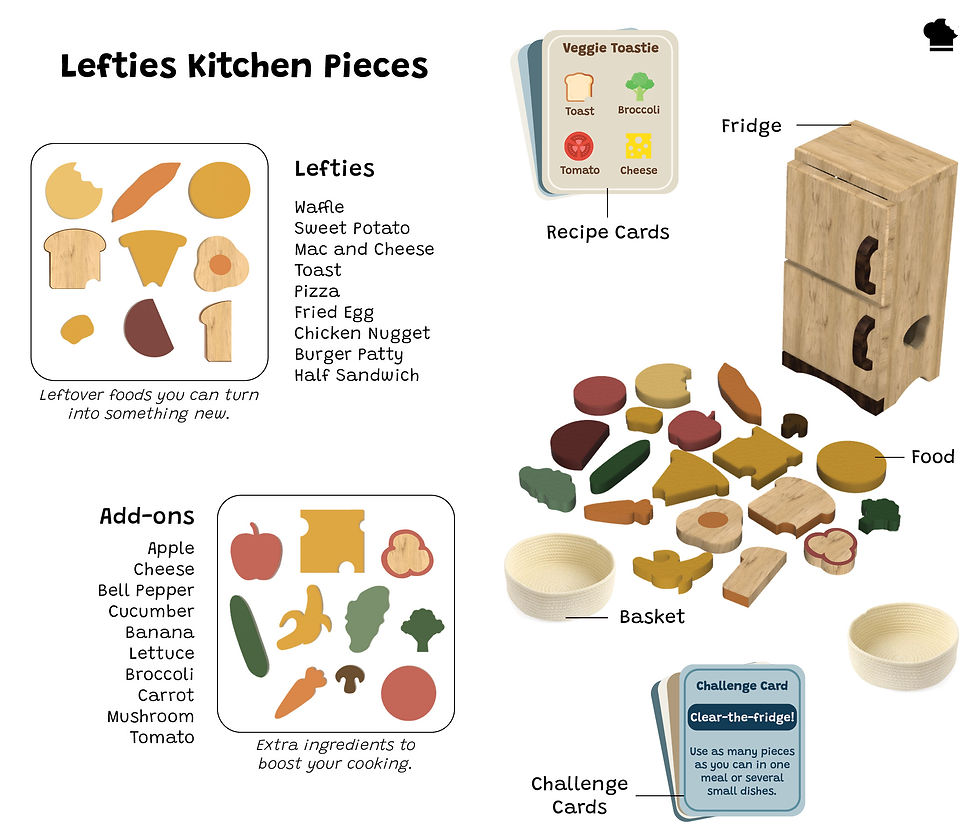
I also considered which foods to include. I asked questions like what leftovers actually look like in a typical fridge, what foods a six-year-old would recognize, and how the set could gently introduce ideas around balanced meals with fruits and vegetables without feeling instructional.
From there, I explored how familiar foods could be abstracted into playful forms that still felt recognizable. Each “leftie” piece is designed to connect, stack, and transform, encouraging experimentation rather than replication.
There is no right way to build a meal. The toy prioritizes flexibility, creativity, and discovery, reflecting how leftovers can be reimagined in real life.
_edited.jpg)
04
Bringing Lefties Kitchen to Life
This is might just be my favorite part of the design process.
The forms are soft and approachable, scaled for small hands and repeated use. Materials were chosen with durability and reuse in mind, reinforcing the product’s values through its physical design. I modeled Lefties Kitchen in Fusion 360 and CNC cut all 33 wooden pieces to start.
Each piece was hand-sanded and assembled by hand. I built the fridge structure, recessed the hinges using a drill press so the doors sat flush, and added small magnets to reinforce the doors.
All food pieces are hand-painted and finished with small velcro elements to support building and recombination during play.
05
Final Design
The final system includes modular food pieces, recipe cards, and challenge prompts that encourage kids to see leftovers as a starting point.
By building meals from what is already there, kids begin to understand reuse as something intuitive and creative, not restrictive.


06
Want to become a lefties chef?